The Semiconductor Industry Is Optimizing the Wrong Problem
Vault Track: #11 | Sealed on 2026-07-16
Communication has become part of computation.
For most of the last half-century, the semiconductor industry had a remarkably successful strategy: keep shrinking the transistor. That strategy transformed computing. It may no longer be enough.
The primary bottleneck is beginning to shift. It is no longer only about how fast we compute — it is increasingly about how efficiently we move information. We have spent decades optimizing computation. The constraint has quietly moved elsewhere.
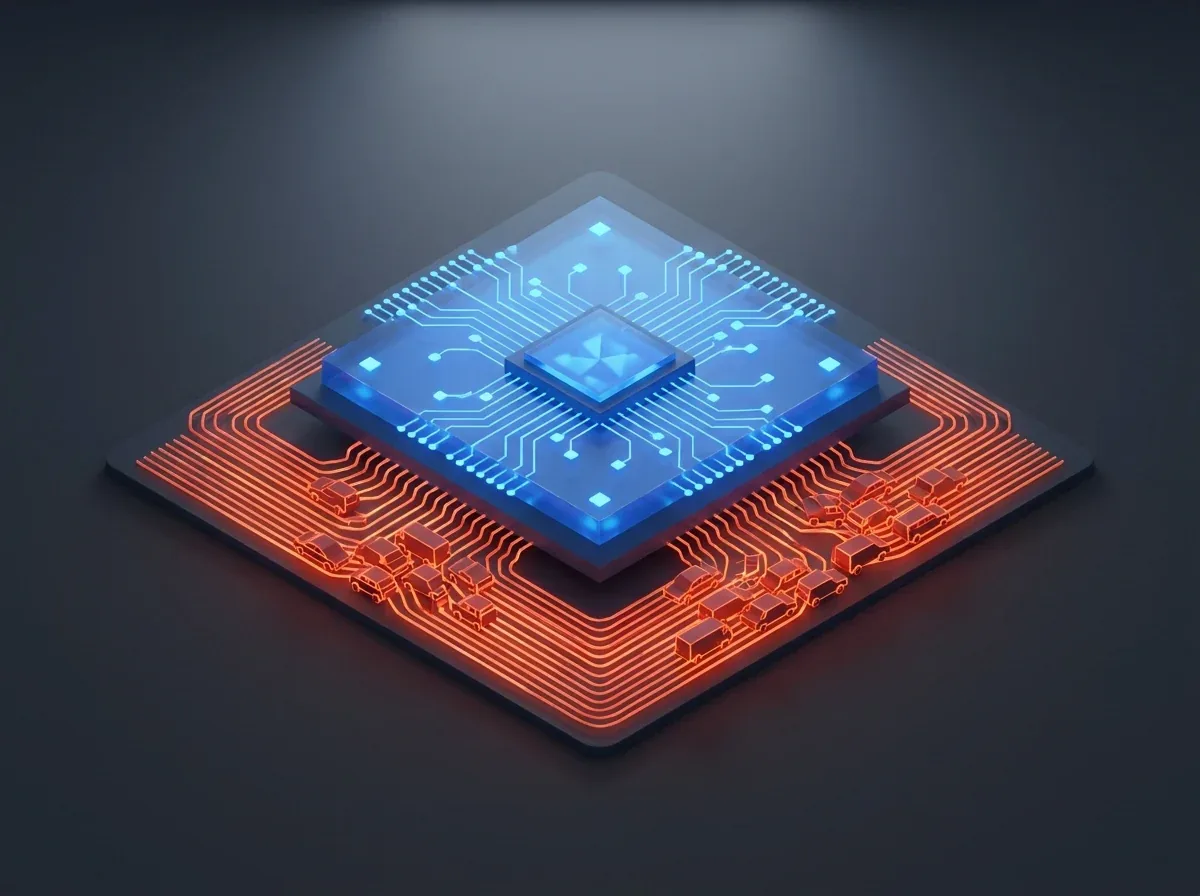
Copper Isn't Failing. We're Just Asking Too Much of It.
Engineers have been brilliant at extending the life of electrical architectures. High Bandwidth Memory (HBM) and advanced packaging are masterpieces of this effort, shrinking the physical distance between processors to stave off the inevitable.
But each improvement solves the same problem a little longer — without changing the underlying medium. Copper isn't failing; we are simply asking too much of it.
Every bit transferred through copper costs energy, and every longer electrical path invites resistance, signal integrity decay, and heat. As AI systems scale, these penalties compound rather than simply add up. Broadcom's Tomahawk 6 switch, already shipping, delivers roughly 3.5x the power efficiency of the pluggable optics it replaces — a gap wide enough that it's no longer a rounding error in a system's power budget.
We are building systems where internal communication is becoming as expensive as computation itself.
The Optics Pivot

Silicon photonics is not a new discovery. It has lived in the "future" for twenty years, waiting for the right moment. That moment appears to have arrived: TSMC's COUPE platform entered mass production this year, marking one of the first transitions from laboratory promise to commercial deployment.
Replacing electrical I/O with optical links isn't about replacing the logic processor; it's about decoupling compute from the communication tax. If you can move information with less energy, you reclaim the power budget for compute.
The bottleneck no longer lives inside the processor. Increasingly, it lives between processors — and for the first time, the supply chain to fix that is shipping in volume rather than sitting in a lab.
The Innovator's Dilemma
So why haven't we switched sooner?
The answer has less to do with engineering than economics, and the economics are specific: hundreds of billions of dollars are sunk into fabs, packaging lines, and validation toolchains built around electrical I/O. A hyperscaler's entire software stack, from network topology to congestion control, assumes copper's latency and failure characteristics. Switching means requalifying components, retraining supply chains, and absorbing the capital cost of infrastructure that isn't yet fully depreciated. None of that is a technology problem — it's a switching-cost problem, and switching costs are precisely what make profitable incumbents slow.
History rarely rewards incumbents for recognizing change. It rewards them for acting before their existing business gives them permission to.
Safe bets create openings. Incumbents play the long, rational game of gradual evolution, protecting depreciated capital. That caution is exactly what leaves the door open for new entrants: Ayar Labs raised $500 million this year to fund volume production of its optical chiplets. It owns no leading-edge logic fab. It didn't need one.
A New Map of Power

Unlike cutting-edge CPUs, many photonic components do not require the industry's most advanced manufacturing nodes. Waveguides and passive optical structures are comfortable in mature process nodes — which is precisely why a foundry with no presence in leading-edge logic can now ship its own co-packaged optics platform.
This changes the competitive map. Research leadership, optical materials, advanced packaging, and manufacturing scale are increasingly distributed across different companies and regions, rather than concentrated in whoever holds the most advanced logic node.
The industry is no longer being built solely in the shadow of the world's most advanced logic fabs. We are witnessing the emergence of a distributed supply chain, one where leadership depends as much on packaging, materials, and system integration as it does on transistor density.
AI's Physical Reality
The data center is forgiving. The physical world isn't.
Autonomous vehicles, robotics, and edge AI don't have the luxury of a data center's cooling tower or its megawatt power feed. In these environments, moving data isn't a performance optimization; it's a hard constraint on what the system can do at all.
When the model grows but the power budget doesn't, communication efficiency stops being a performance feature and becomes a design constraint.
The Wrong Metric
We are still obsessed with nanometers. Two nanometers. One point four. They make for good headlines.
But if AI is increasingly constrained by communication rather than computation, nanometers are measuring the wrong axis of progress. The more telling numbers in 2026 aren't process nodes — they're terabits per second per watt, and how many of a switch's total transistors are now devoted to photonics rather than logic.
The next semiconductor race won't be decided solely by who shrinks a transistor first. It will be decided by who makes information cheapest to move. And this year, for the first time, that race has a scoreboard.
Moore's Law made computation cheap. The next decade may belong to whoever makes communication cheap.
Comments
Anonymous comments — set a password to delete your own later.
Loading comments…
Have any suggestions or found a bug in this recipe?
💡 Submit Your Feedback