Your Brain Is Being Refactored
Vault Track: #10 | Sealed on 2026-07-15
The Architecture of Human Thought
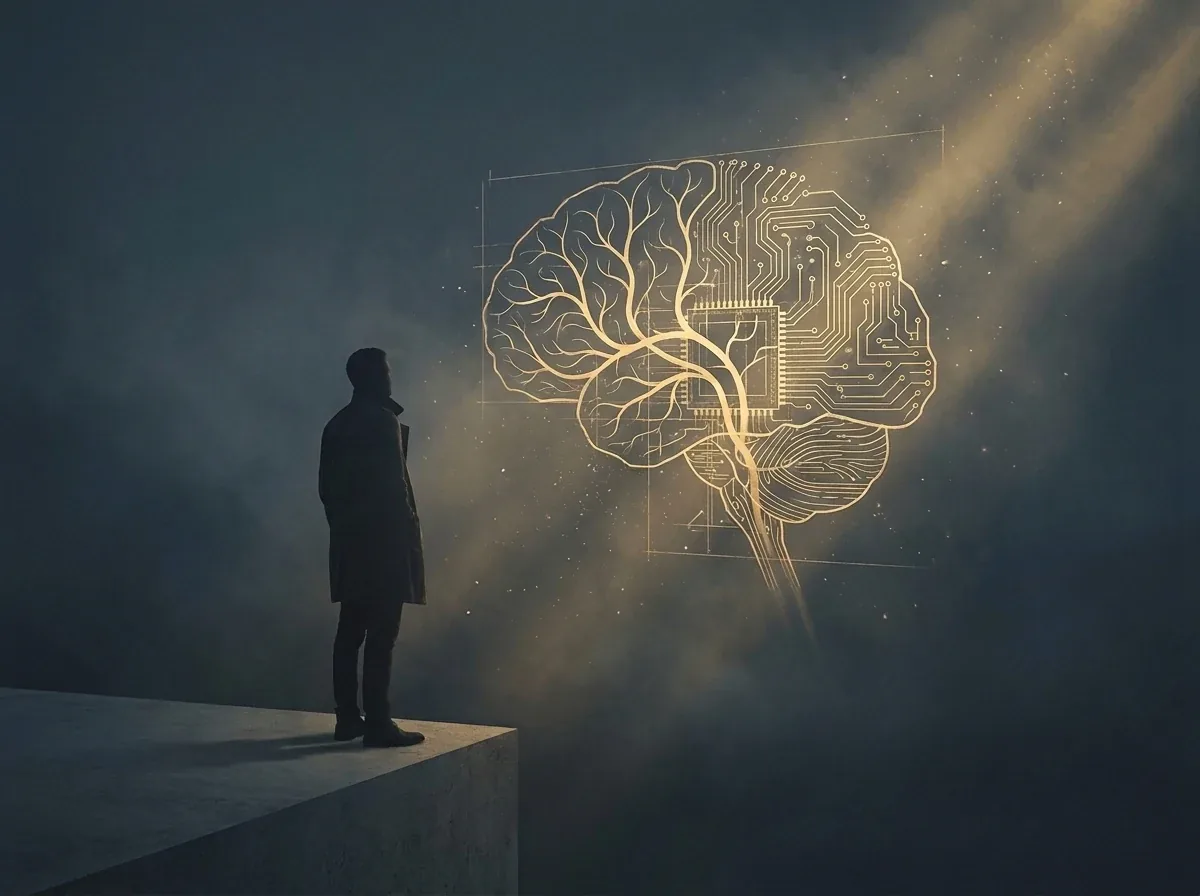
The long history of cognitive offloading, from numbers to large language models.
Chapter 1: Before AI, There Were Numbers
Every generation believes its technological revolution is different.
History is usually less dramatic.
Today, we talk about large language models as though they appeared out of nowhere. History rarely works that way.
The tools change. The pattern doesn't.
Before we talk about AI, it's worth looking at a much older invention.
Numbers.
Long before we built computers, humanity had already discovered something profound: the brain does not need to perform every mental task by itself. Cognitive psychologists describe this as cognitive offloading. In software terms, the brain has been slowly turning itself into an operating system—allocating resources, managing state, and delegating execution to external hardware.
Imagine a world without numbers.
A shepherd tries to remember how many sheep left the valley. A merchant recalls who owes what. Every quantity exists only inside biological memory. The brain acts as processor, storage, and retrieval system all at once.
It works.
Until it doesn't.
As societies grew—more people, more trade—those biological limits became expensive. The problem wasn't intelligence.
The problem was architecture.
So humanity expanded its environment. We invented an abstract system that allowed quantities to exist outside the mind. Marks carved into bone. Symbols pressed into clay.
Memory became external.

That single shift changed the relationship between humans and thought itself. The brain no longer carried every piece of information alone. Not because numbers made us smarter. Because they changed where intelligence spent its effort.
That pattern would repeat itself.
The abacus externalized computational state.
Calculators automated mechanical computation.
Computers industrialized memory.
The Internet transformed retrieval into a networked problem.
Large language models extend that trajectory into synthesis and contextual organization.
They form a continuous lineage. For thousands of years, humanity has been moving mental work to external systems so the mind can operate at a higher level.
Chapter 2: The Long History of Cognitive Offloading
One of the easiest mistakes to make is treating technological progress as a collection of unrelated inventions.
The printing press solved one problem. The calculator another.
From a systems perspective, these are successive iterations of the same architectural decision. Whenever the human brain became the bottleneck, we moved part of its workload somewhere else.
The destination changed. The pattern never did.
The abacus is often described as an ancient calculator. It wasn't. Its real innovation was giving computation a physical state. Before the abacus, every intermediate step of a calculation had to remain alive inside working memory.
The beads solved that problem. You didn't have to remember the state; you could see it.

The mental burden didn't disappear. It moved.
The calculator pushed that boundary further. The abacus still depended on human execution. The calculator quietly eliminated that responsibility. For the first time, mechanical computation became almost free.
Society didn't become full of worse mathematicians. Mathematics itself moved upward. Engineers spent less time performing calculations and more time deciding which calculations mattered.
Computers repeated the pattern for memory.
Human memory is associative and creative, but archival storage has never been its strength. Libraries became databases. Ledgers became spreadsheets.
The question was no longer: "Can I remember this?"
It became: "Can I retrieve it?"
The Internet expanded the architecture again. Storage was no longer local. It became distributed across a planetary network. Expertise transitioned from possession to navigation. Knowing where trustworthy information lives became as valuable as remembering it.
Large language models extend that same trajectory.
Search retrieves.
Language models organize.
One returns documents.
The other returns structure.
For the first time, a tool is operating on something that feels remarkably close to reasoning itself. Which explains why this moment feels different.
Not because history suddenly changed. But because the boundary has reached a part of the mind we assumed belonged exclusively to us.
Chapter 3: The Most Misunderstood Thing About AI
Every major cognitive technology has been met with skepticism.
In Phaedrus, Plato has Socrates warn that writing would create "forgetfulness in their souls," as people relied on external symbols rather than memory. Printed books would encourage intellectual laziness. Calculators would destroy arithmetic. Search engines would make us stop learning.
We adapted.
Yet the arrival of large language models feels different. It appears to touch something we believed was uniquely ours.
Thinking.
Notice what happened in previous transitions. Numbers never decided what to count. Calculators never chose the equation. Search engines never determined which question was worth asking.
Each tool accelerated a process without challenging the human directing it.
LLMs feel different because they participate in the process that comes before an answer exists. You ask a question. A coherent argument appears. For many, this feels like outsourcing thought.
But perception isn't architecture.
What exactly are we calling "thinking"?
If generating boilerplate code or summarizing twenty documents is thinking, then machines are already remarkably capable.
Many of the activities we casually label as thinking are, in reality, execution. And execution has always been the first thing humans externalize.
Software engineering offers a useful analogy. A mature organization doesn't ask senior architects to fix indentation or manually update configuration files. Not because those tasks are unimportant, but because they occupy the wrong layer. The organization scales by moving repetitive responsibilities downward, preserving human judgment for leverage.
Civilizations evolve similarly.
Each generation develops tools that absorb another category of repetitive mental work. Not to eliminate human intelligence. To reposition it.
When Garry Kasparov lost to Deep Blue, many assumed chess had reached an endpoint. It hadn't. Chess didn't become less human. Grandmasters learned from engines. New positional ideas emerged. Players embraced "centaur chess"—human-machine collaboration.

The machine didn't remove strategy. It expanded the strategic landscape. The layer of valuable thinking moved upward.
The real disruption isn't that machines suddenly learned to think. It's that much of what we proudly called thinking consists of structured cognitive labor that can be externalized.
The most important question of this era isn't "Can machines think?"
It is: "What kind of thinking remains uniquely valuable once another layer has been externalized?"
Chapter 4: Thinking at a Higher Layer
Software engineers eventually learn an uncomfortable lesson.
As systems grow, writing code becomes a surprisingly small part of the job. Junior engineers believe the best developer writes the most code. Experience produces the opposite conclusion.
The engineers with the greatest impact define the problem correctly before anyone writes a single line.
Architecture scales.
Implementation accumulates.
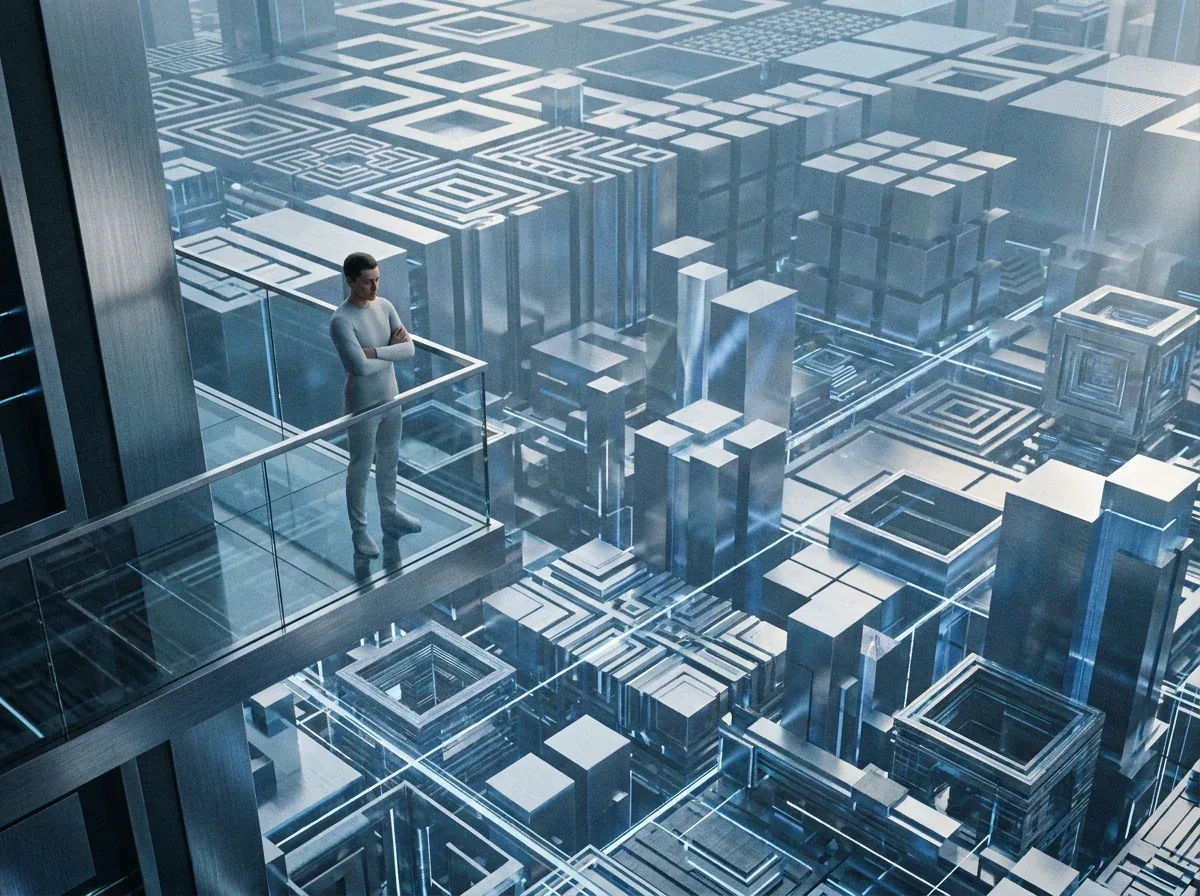
The same pattern appears throughout the history of human cognition. Every technological advance has quietly moved humans one layer higher in the cognitive stack. When calculators became cheap, arithmetic lost economic value while mathematical modeling gained it. When the Internet connected knowledge, finding trustworthy information became more valuable than possessing it.
Each transition looked, at first, like a loss. Each eventually became an upgrade.
Large language models continue that progression. They change where thinking creates leverage.
Not long ago, being a strong writer meant producing polished sentences quickly. Increasingly, that isn't the bottleneck. Language models can draft reports and documentation in seconds.
The scarce resource is deciding what deserves to be said.
Logic has become more valuable than prose. Intent more valuable than phrasing. Direction more valuable than execution.
For decades, programming largely meant translating ideas into syntax. Much of that work is becoming automated. Yet experienced engineers have not become irrelevant. Someone still has to decide where services begin and end. Where trust boundaries exist. Which abstractions deserve to exist.
Programming was never the act of typing.
Typing was simply the interface.
The keyboard was never the scarce resource.
Judgment was.
Execution compounds only after direction has been chosen. AI doesn't reduce the importance of judgment. It concentrates it. As lower layers become inexpensive, the remaining layers become disproportionately valuable.
Problem framing.
Systems thinking.
The ability to distinguish signal from noise.
Every time we externalize one layer of mental work, another becomes visible.
Chapter 5: Refactoring Isn't Optimization
Software engineers often confuse optimization with refactoring.
Optimization is about speed. The software behaves the same, only faster.
Refactoring is about structure. The external behavior barely changes, but the internal architecture changes completely.
Something similar is happening to us.
Much of today's conversation assumes AI exists to make humans faster. Speed matters, but it has rarely been the deepest consequence of a new cognitive tool. Numbers were not primarily about faster counting. Writing was not primarily about faster remembering. Computers were not primarily about faster filing.
Each technology quietly reorganized how human thought itself was structured. Architecture came first. Performance followed.
The greatest contribution of language models may not be accelerating the work we already do. It may be changing how that work is divided.
When repetitive reasoning becomes inexpensive, judgment becomes more valuable. When drafting becomes free, deciding becomes important.
The bottleneck moves.
History rewards societies that know what to do with newly available mental capacity. When writing reduced the burden of memory, philosophy flourished. When printing democratized knowledge, science accelerated.
If lower-level mental work migrates to machines, something important is left behind.
Attention.
Judgment.
Intentionality.
Those resources do not remain empty for long. They are either invested or consumed. Technology rarely decides between them.
People do.
We never stopped thinking. We simply kept relocating the parts that no longer required our direct attention. Each generation inherited tools that removed another layer of mental labor. Each generation was then asked to operate one layer higher.
Your brain is not becoming obsolete. It is reorganizing itself around a different set of responsibilities.
From numbers.
To the abacus.
To calculators.
To computers.
To the Internet.
And now, to large language models.
For thousands of years, humanity has been refactoring the architecture of its own cognition.
Technology is not the history of building smarter machines.
It is the history of deciding which mental work belongs outside the human mind.
Comments
Anonymous comments — set a password to delete your own later.
Loading comments…
Have any suggestions or found a bug in this recipe?
💡 Submit Your Feedback