The Illusion of Volume vs. AI Weight Calibration
Vault Track: #1 | Sealed on 2026-06-17
1. Executive Summary: Why Volumetric Measurements are Ruining Commercial Yield
- Traditional volume metrics (tablespoons, cups, fluid ounces) introduce catastrophic margin errors due to physics and material density.
- While a flat tablespoon of pure liquid remains stable, high-viscosity pastes (like Gochujang) or porous granules (like Gochutgaru) create a 100% to 300% mass variance depending on surface tension, cohesion, and air pockets.
- CalcRecipe's AI Engine eliminates this variance. By automatically translating raw volumetric inputs into precise metric weights (grams/kilograms) and cross-referencing material density, we ensure absolute consistency for global professional kitchens.
2. Core Density Matrix: The Physics of Common Kitchen Ingredients
| Ingredient Category | Stated Volumetric Metric | Real-World Mass Variance | Density Flaw: Why Volume Lies |
| 💧 Pure Liquids(Soy Sauce, Mirin, Water) | 1 Tablespoon (tbsp) | ~15g(Flat) | Strictly governed by fluid mechanics. Surface tension limits excessive accumulation. However, standard dinner spoon depths and bowl shapes vary wildly, introducing inherent measurement flaws. |
| 🍯 High-Viscosity Pastes(Gochujang, Doenjang, Honey) | 1 Tablespoon (tbsp) | 35g – 45g(Heaped) | High cohesion and viscosity allow the ingredient to pile up significantly. A single casual scoop can effortlessly double or triple your sugar and sodium levels instantly. |
| 🌶️ Porous Granules(Gochutgaru, Flour, Sugar) | 1 Cup / 1 Tablespoon | 7g – 15g(Variable) | Fluffy particles trap countless air pockets. Factors like ambient humidity and how tightly the ingredient is packed can shift the real density and mass by over 100%. |
3. The AI Scaling Solution: Dynamic Unit Switching (pax / g / kg / L / lb / oz)
To resolve this structural flaw without forcing chefs to manually compute density math, CalcRecipe implements a 2-Step AI Calibration:
- The Ingestion Phase (Back-end AI): When raw text or US Imperial measurements (cups, lbs, oz) are introduced, the AI auto-calculates the ingredient’s specific gravity and stores it in absolute standard grams (g).
- The Scaling Phase (Front-end Engine): The user can dynamically toggle between global standards:Mass-to-Mass Scaling: Convert and multiply from 1kg of base paste to 25kg bulk yields.Cross-Border Conversion: Toggle between 🇺🇸 US Imperial (oz/lb) and 🇪🇺 Metric (g/kg) with real-time density adjustments applied per ingredient.
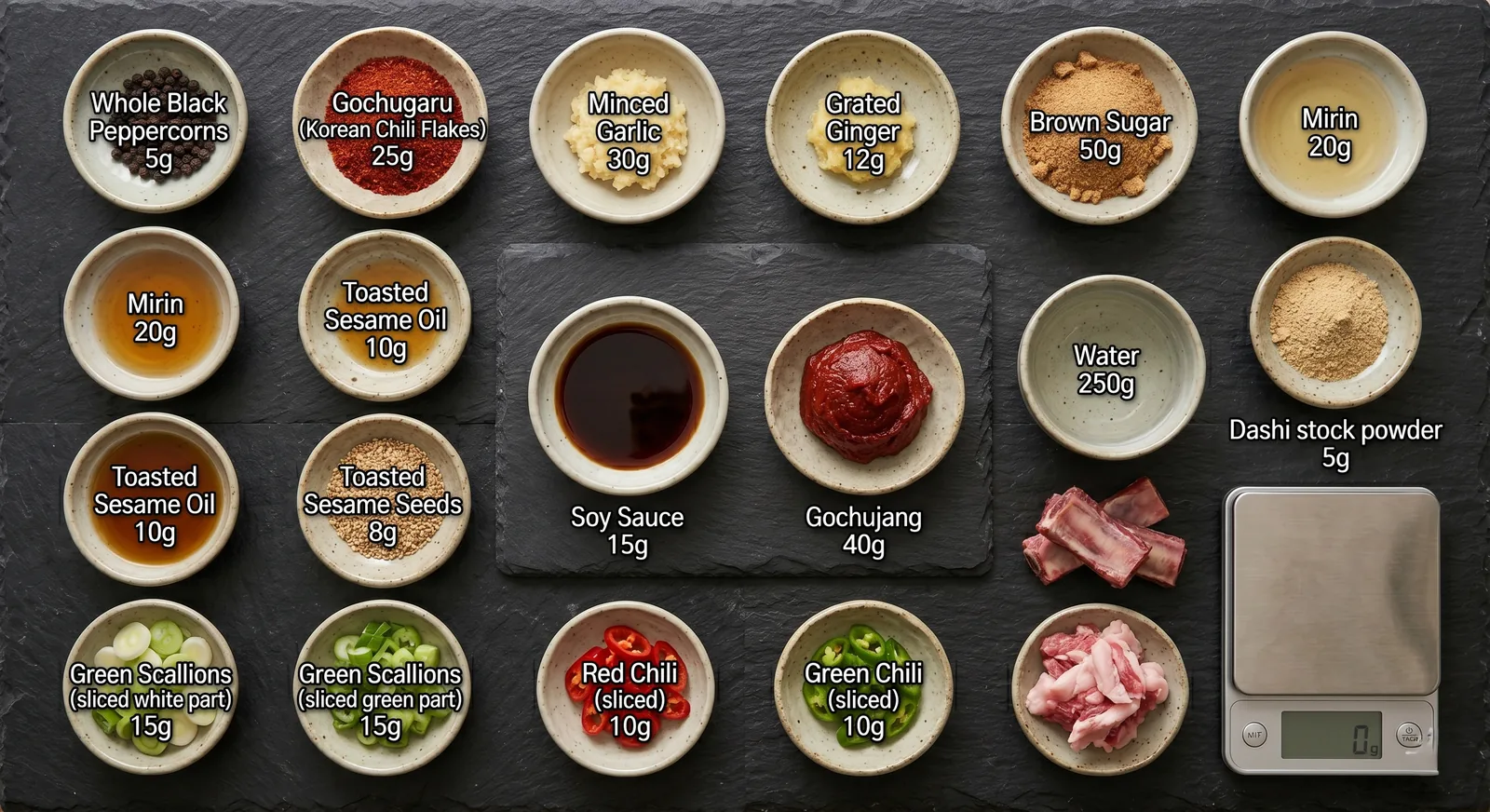
Scaling This Recipe: The Illusion of Volume vs. AI Weight Calibration
This vault entry is built for operational scaling in professional kitchens. The embedded calculator converts each ingredient to a gram-based baseline, then multiplies every line by your target batch ratio.
When ingredients were entered with volumetric source data, CalcRecipe applied density calibration so a tablespoon of paste does not scale like a tablespoon of water.
Return to the AI Scaler on the food page, or browse more formulations in the Chef's Vault.
Have any suggestions or found a bug in this recipe?
💡 Submit Your Feedback